



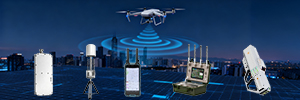
Classification of anti drone products

date:2025.10.23

Views: 214
Classification of anti drone products
1 .Primary Detection Methods & Technical Characteristics
RF Spectrum Monitoring
Technical Principle: A passive detection technology that listens for communication signals between the drone and its remote controller (pilot), including video transmission, remote control signals, and GPS/BeiDou navigation signals, to detect and locate drones.
Radar Detection
Technical Principle: Similar to traditional radar, counter-drone radar emits electromagnetic waves into the surrounding airspace and receives echoes reflected from the drone’s body to detect targets and calculate their distance, speed, and direction.Electro-Optical Detection
Technical Principle: Uses visible-light cameras and infrared thermal imaging cameras to scan and monitor airspace, detecting, identifying, and tracking drones through visible or thermal radiation images.
Acoustic Detection
Technical Principle: Employs highly sensitive microphone arrays to capture the unique audio signatures produced by drone rotors and motors during flight. Soundprint matching and pattern recognition algorithms are used to detect and identify drones.
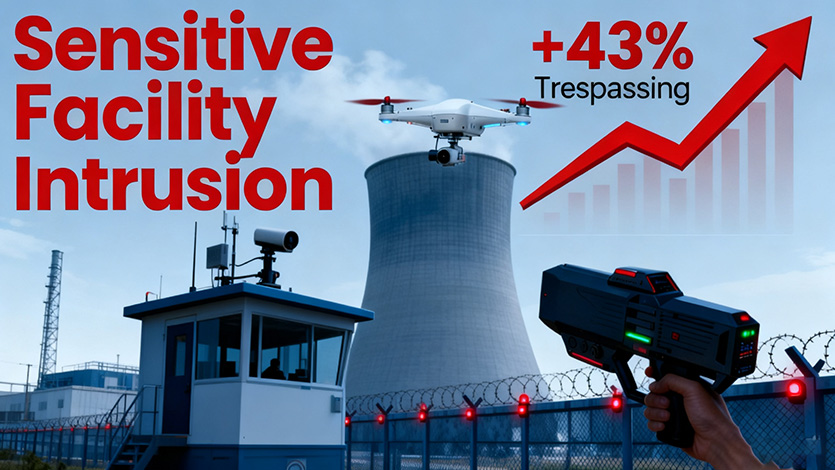
2. Primary Countermeasure Methods & Technologies
RF Signal Jamming
Blocks remote control and navigation signals, forcing the drone to land or return. Low collateral damage, widely applicable.
Navigation Spoofing
Transmits false GPS signals to lure the drone to a safe area or force it to land. Technically demanding.
High-Energy Laser Weapons
Precisely burns critical components, offers instantaneous engagement. High overall cost, suitable for point defense.
High-Power Microwave (HPM)
Provides wide-area electromagnetic coverage, effective against swarm attacks. Damages all electronics in the area, risk of significant collateral damage.

3. Classification of Counter-Drone Products
The products are divided into two categories based on their usage scenarios: fixed and portable. Fixed type is a large-scale equipment mainly used in a fixed defense location, setting up equipment at high altitudes and detecting and interfering with a wide range of low altitudes. Portable is a small device mainly used for convenient and fast use, and can be carried by individual soldiers and moved
| Detection | Jamming | Integrated Detection & Neutralization | |
| Fixed | Fixed RF Detection & Positioning Equipment | Fixed Drone Jammer Chassis | Detection and jamming systems can be combined into integrated solutions |
| Low-Altitude Small Radar Detection Equipment | |||
| Low-Altitude Electro-Optical Detection Equipment | |||
| Handheld Drone Detection & Positioning Equipment | Drone Jammer Gun | Integrated Detection & Neutralization Gun | |
| Portable | Dual-Antenna Drone Detection Equipment | ||
| Vehicle-Mounted | Vehicle-Mounted Detection | Vehicle-Mounted Jamming | Vehicle-Mounted Integrated Detection & Neutralization |
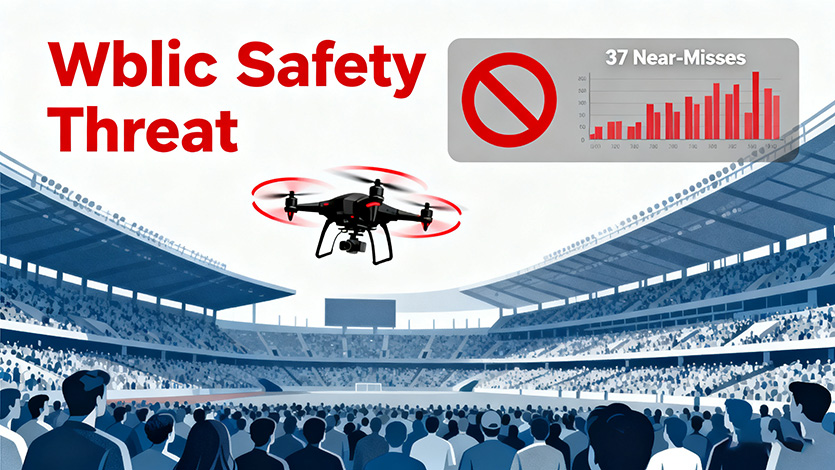
4. How to Choose the Right Counter-Drone Product for You
Based on the product classification, first determine whether you need drone detection, countermeasures, or both. Then, consider the area to be defended:
For large, fixed defense perimeters, choose fixed systems.
For small, mobile defense areas, opt for portable systems.
For large, mobile coverage needs, vehicle-mounted systems are suitable.
If you are unsure, provide the specific area or location you wish to defend, and our technical team can assist in recommending the appropriate product configuration.




18824309650

info@tatusky.com
Newsletter
Submit


